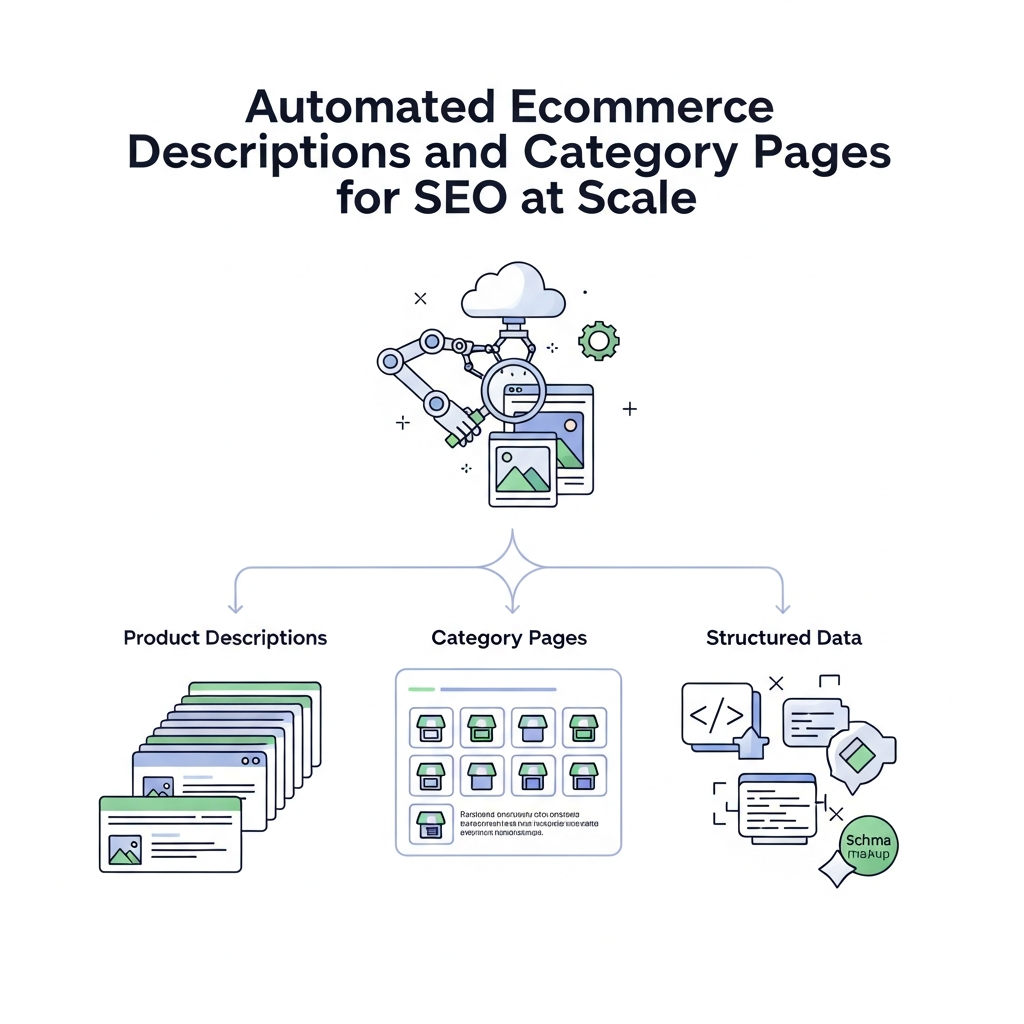
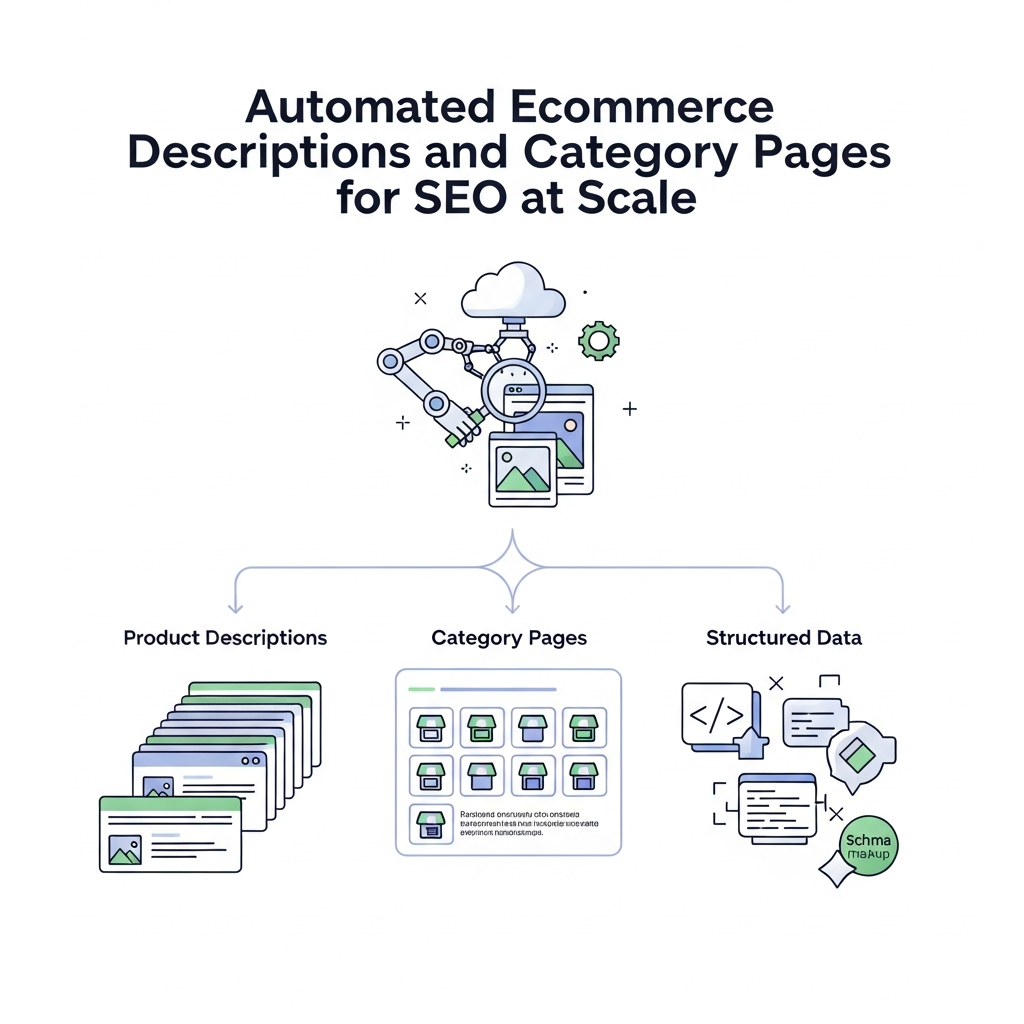
Automated Ecommerce Descriptions and Category Pages for SEO at Scale
- Introduction
- Why automate product descriptions and category pages
- Core components of scalable ecommerce SEO automation
- Architecture options for scale
- Crafting high-conversion product descriptions
- Optimizing category pages at scale
- QA, governance, and templates
- Measuring success and building a roadmap
- Checklist and next steps
Introduction
For ecommerce brands, product descriptions and category pages are more than just catalog entries. They are powerful signals to search engines and critical touchpoints for conversion. When done at scale, manual writing becomes a bottleneck that hurts launch velocity and revenue. This article explains how to automate product descriptions optimization and category page optimization so you can improve rankings, user experience, and conversions without sacrificing brand voice.We’ll explore templates, structured data, canonical and alt text management, and data-driven workflows that integrate with your CMS. Along the way, you’ll find practical steps, checklists, and architecture patterns you can adapt to your tech stack. If you’re seeking a scalable framework to drive ecommerce SEO automation, you’ve landed in the right place.As you read, consider how automation can complement human oversight rather than replace it. The goal is to maintain quality while accelerating production, alignment, and measurement. For a broader look at how automation can fit into your marketing stack, visit our homepage and explore platform capabilities. You can also review our terms and policy at Terms & Conditions and Disclaimer anytime.
Why automate product descriptions and category pages
Automation addresses three core needs in ecommerce SEO: scale, consistency, and speed. As catalogs grow, keeping descriptions fresh, unique, and optimized across hundreds or thousands of SKUs becomes impractical to do manually. Automation helps you:
- Scale content production while preserving brand voice through templates and governance rules.
- Maintain consistent on-page signals such as title tags, meta descriptions, and structured data.
- Accelerate time-to-market for new products and categories, reducing time-to-rank.
Beyond quantity, automation enables better decision making. Data-driven templates can adapt to seasonality, category nuances, and language variations, while centralized dashboards reveal where you gain or lose visibility. This approach supports both product pages and category landing pages, which often drive a large portion of navigational traffic and revenue.
Core components of scalable ecommerce SEO automation
To build a scalable system, focus on a few non-negotiable components that work in concert. Each piece supports both product descriptions optimization and category page optimization.
1) Templates for product descriptions
Templates anchor your voice, structure, and required fields while allowing variation across SKUs. A solid template includes a unique value proposition, key features, dimensions/specs, usage guidance, and a brief buying rationale. It should be data-driven so you can plug in attributes such as color, size, material, and compatibility. With templates, you achieve consistency, speed, and easier localization.
2) Structured data and schema markup
Structured data enhances search visibility by providing explicit information about products, reviews, availability, pricing, and more. Implement JSON-LD markup that covers product scope, breadcrumbs, and site navigation. Extend schema to category pages with catalog and filter information so search engines understand the site architecture and user intent behind pages.
3) Canonical and alt text management
Canonical URLs prevent duplicate content from diluting signals when multiple pages serve similar intents. Alt text should describe imagery for accessibility and provide SEO signals about product attributes. Automating canonical control and image alt text ensures consistency at scale across catalogs and marketplaces.
4) SEO-friendly product data and metadata
Automate generation of SEO-friendly product data, including descriptive titles, keyword-informed meta descriptions, and structured attributes. Metadata should reflect intent, rank-competitiveness, and localization needs, while remaining aligned with brand voice.
5) Templates for product descriptions and localization
Localization is a feature, not an afterthought. Use adaptable templates that support multilingual product descriptions and category pages. Centralize language-specific terms, currency formats, and cultural nuances to maintain consistency across markets.
6) Ecommerce SEO automation and workflow orchestration
Automation should span ideation, writing, publishing, linking, and optimization. A clean workflow automates keyword discovery, content brief generation, draft creation, CMS publishing, internal linking, and performance reporting. A single source of truth prevents disparate outputs and keeps teams aligned.
Architecture options for scale
The right architecture depends on your catalog size, CMS, localization needs, and whether you prefer a single platform or a hybrid stack. Here are two common patterns:
Option A: End-to-end single-platform automation
This pattern relies on one platform to generate content, manage metadata, apply structured data, and publish to your CMS. It often includes an AI writing module, templates, a rule-based editor, and a built-in CMS connector. Benefits include faster iteration, simpler governance, and cohesive analytics. Key considerations are ensuring role-based access, white-label reporting, and multi-brand support for agencies or franchises.
Option B: Hybrid workflow with CMS-first publishing
In this setup, content briefs and AI-generated drafts feed a CMS workflow with human editors who finalize outputs. Automation handles data population, schema, and internal linking, while editorial teams ensure brand voice and accuracy. This approach mitigates quality risk for complex products and localized markets, and it pairs well with robust QA gates and version control.Regardless of the model, ensure you have clear ownership for templates, schema mappings, and updating rules. Maintain a change log and a rollback plan to protect catalog integrity during product launches or seasonality shifts.Integrations matter. You’ll benefit from connections to your ecommerce platform (Shopify, Magento, BigCommerce, etc.), your CMS (WordPress, Webflow, etc.), and your analytics stack. See how these integrations support our platform and how you can connect to your existing tools via APIs or native connectors.
Crafting high-conversion product descriptions
Quality product descriptions combine clarity, benefits, and trust signals. Automation does not mean sacrificing storytelling; it means providing a repeatable framework that scales without eroding brand voice.
Framework: A.I.D.E (Attention, Interest, Detail, Endorsements)
- Attention: Open with a crisp benefit or problem solved by the product.
- Interest: Highlight distinctive features and usage scenarios.
- Detail: Provide specs, materials, sizes, compatibility, and care instructions.
- Endorsements: Include credibility signals such as warranties, certifications, or user testimonials (when available).
Balance is key. Use concise, scannable paragraphs, bullets, and feature bullets that map to user intents (price sensitivity, performance, durability). Automate the generation of variants that emphasize different angles—value-driven, feature-driven, or risk-reducing messaging—so you can A/B test what resonates with shoppers.To ensure accessibility and usability, maintain consistent headings, avoid jargon, and include structured data for product pages. Internal linking to related products and category pages helps search engines understand relevance and improves session depth for shoppers.
Optimizing category pages at scale
Category pages serve as hubs that guide discovery and influence crawl efficiency. Automating category pages involves both structural optimization and content augmentation that aligns with user intent and search signals.
Best practices for category hubs
- Provide a concise, keyword-informed header that conveys the category’s value proposition.
- Display high-level filters and intuitive navigation to improve user experience and accessibility.
- Offer a short curated description that summarizes why shoppers should explore this category.
Automation can populate category descriptions from a centralized template while inserting category-specific attributes, such as best-selling subcategories or seasonal highlights. Use structured data to mark up breadcrumbs, category schema, and product listings, enabling rich results and better internal linking signals.Additionally, apply canonical URLs where necessary to avoid duplicate content across pagination and filtering. This helps concentrate authority on the primary listing while preserving user-friendly navigation.For multilingual sites, create locale-aware meta descriptions and headings that reflect local search intent. This improves visibility in regional SERPs and supports global growth.
QA, governance, and templates
Governance ensures outputs stay on-brand and compliant with your data and UX standards. A robust governance model includes:
- Editorial guidelines for tone, terminology, and risk signals.
- QA gates that validate metadata, structured data, and canonical URLs before publishing.
- Version control for templates and content blocks.
- Change management for updates tied to product launches or policy changes.
Templates should be living documents. Schedule quarterly reviews to align with evolving SEO signals, search intent shifts, and catalog changes. Automate QA checks for key signals such as missing alt text, broken links, stale pricing, and incorrect schema mappings.To maintain quality while scaling, combine automated checks with human review at critical stages (e.g., new product launches, localized variants). This hybrid approach reduces risk while preserving speed.
Measuring success and building a roadmap
Automation without measurement can drift away from business goals. Establish a metrics framework that covers both search performance and on-site behavior. Core metrics include:
- Indexing speed and crawl coverage for new pages
- On-page optimization signals (title relevance, meta quality, and schema accuracy)
- Structured data coverage and rich results appearance
- Category page engagement (time on page, bounce rate, click-through rate on filter changes)
- Conversion signals (add-to-cart rate, checkout initiation, and revenue per visit)
Use dashboards that aggregate data from your CMS, ecommerce platform, and analytics tools. Track progress by catalog segment, language, and region to understand where automation delivers the most value. Regular reviews help you refine templates, update data feeds, and adjust thresholds for QA gates.As you plan, design a 90-day roadmap that starts with a minimal viable automation layer and gradually expands to multilingual catalogs and deeper category optimization. The goal is to deliver measurable, repeatable improvements in both rankings and conversions.
Checklist and next steps
Ready to begin your automation journey? Use this quick-start checklist to move from concept to execution:
- Define scope: which products and categories to automate first, and which markets to target.
- Create templates: draft product description templates and category page blurbs with mandatory data fields.
- Map data: define the attributes that will feed the descriptions (color, size, material, compatibility, etc.).
- Set metadata and schema: implement canonical URLs, title tags, meta descriptions, and JSON-LD for products and categories.
- Integrate CMS: ensure smooth publishing to your CMS, with proper error handling and version control.
- QA gates: implement checks for accuracy, tone, and data integrity before going live.
- Monitor and iterate: establish dashboards and cadence for optimization cycles.
For more detailed guidance, you can explore related resources on our site or engage with an appropriate vendor. If you’d like to see a live example of how a scalable automation workflow can look in practice, learn more about our platform.As you evaluate options, consider how automation aligns with your existing tools. If you’re evaluating CMS compatibility or need localized content strategies, you may also find value in resources such as terms and disclaimer relevant to your governance requirements.