AI-Driven Content Pipelines for SaaS: Scale Branded Articles with Governance and Real-Time Research
Table of Contents
Introduction
In a SaaS world defined by rapid feature releases and shifting market signals, content teams face a dual challenge: publish at scale without sacrificing brand integrity, and ensure content remains relevant as data evolves. AI-powered tooling offers a path to scale, governance, and real-time research—if you design the pipeline with intent. This guide explains how to build an end-to-end, governance-led content pipeline tailored for SaaS brands that want to grow organic traffic without diluting their product voice.
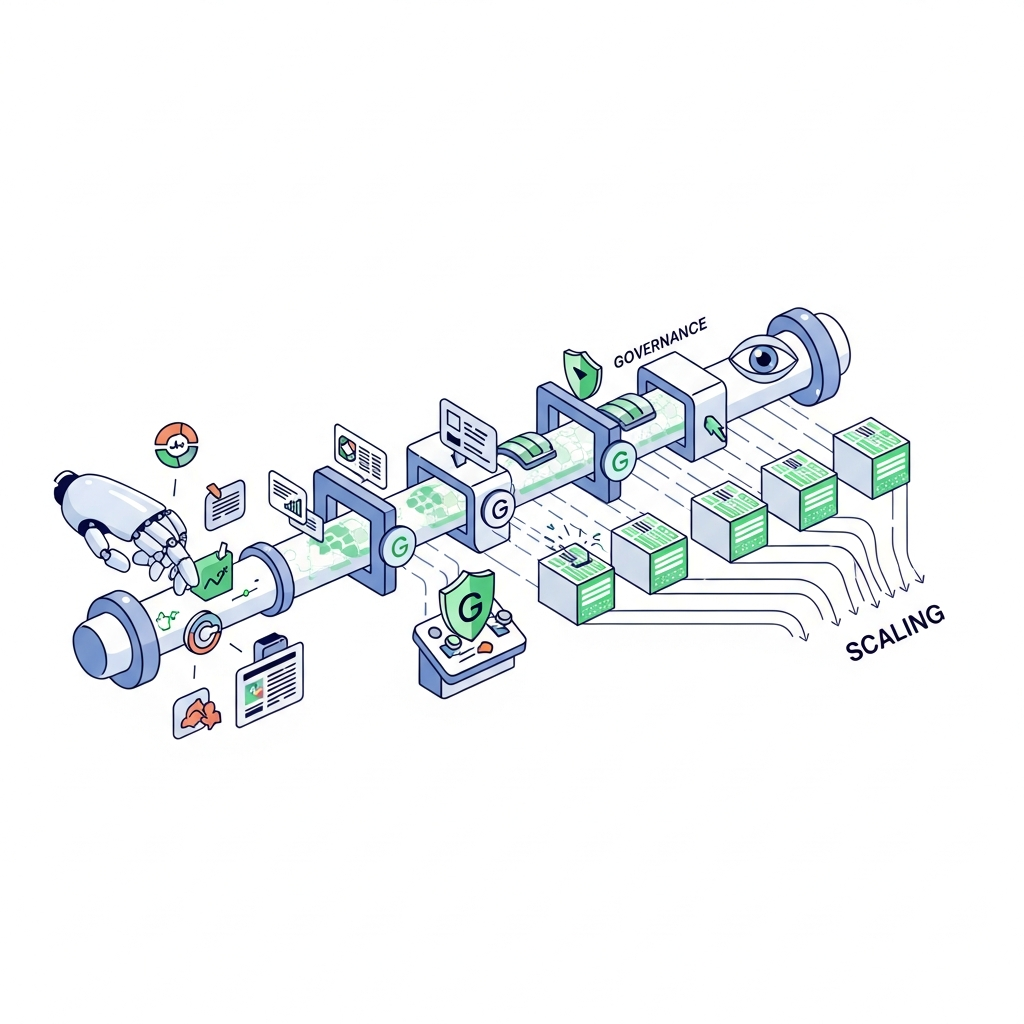
Think of an AI-driven content pipeline as a living system. It ingests credible signals from ongoing research, applies a consistent brand voice, optimizes for SEO with modern techniques, and then publishes across multiple platforms with minimal manual effort. The result is a repeatable, auditable process that aligns content output with your product roadmap and growth targets.
Why AI-Driven Pipelines Matter for SaaS
SaaS brands operate on fast iterations, where customers demand up-to-date information about features, pricing, and best practices. Traditional content workflows struggle to keep pace, leading to stale articles and missed opportunities in AI-first search ecosystems. An AI-driven pipeline combines three core advantages:
- Speed and scale: Generate branded content at volume while preserving voice and accuracy.
- Governance: Maintain a central voice, style, and data standards across topics and teams.
- Real-time relevance: Seamlessly incorporate fresh data, expert quotes, and up-to-date statistics.
Ultimately, the goal is a predictable growth engine: more high-quality content that ranks better, converts more visitors, and supports long-tail traffic across multiple channels.
Architecture and Governance
A robust pipeline rests on three layers: inputs, processing, and delivery. Each layer includes guardrails that preserve brand integrity and data quality.
Inputs: Data Sources and Brand Guidelines
Inputs include brand voice guidelines, editorial standards, data sources for statistics, expert quotes, and a taxonomy of topics relevant to your product. Real-time signals—like feature updates, pricing changes, or customer feedback—serve as the external pulse of the pipeline.
Processing: AI, SEO, and Quality Gates
Processing involves content briefs, prompt libraries, and an optimized LLM control plane. Built-in QA gates verify factual accuracy, alignment with brand voice, and adherence to schema markup requirements before any piece is published.
Delivery: Publishing and Cross-Platform Output
Delivery orchestrates publishing across CMSs and e-commerce platforms via API integrations. The system ensures uniform formatting, metadata, and internal linking, while enabling quick updates when inputs shift.
Brand Voice Governance
Governance is about consistency, not rigidity. Start with a living brand voice document that defines tone, terminology, and style rules. Then encode these rules into prompts, templates, and automated checks that run on every draft.
Components of Effective Governance
- Tone and style guidelines that reflect your product voice
- Glossaries for product terms, acronyms, and metrics
- Content templates tailored to different formats (blogs, case studies, knowledge base)
- QA checks for factual accuracy and data provenance
Governance also includes access controls, versioning, and auditable change history so teams can track how content evolved over time.
Real-Time Research and Data Quality
Real-time research is the backbone of credible, evergreen SaaS content. The pipeline should automatically pull credible statistics, quotes from industry experts, and up-to-date benchmarks from trusted sources. The goal is to assemble a concise data narrative that supports your claims and improves trust with readers.
Practical Ways to Integrate Real-Time Research
- Establish trusted sources and citation rules, including when and how to quote experts.
- Use a live data feed or scheduled data pulls to keep numbers current.
- Embed statistics and quotes with clear provenance in the article template.
Quality checks should validate source credibility, date stamps, and the absence of outdated information before publication.
Schema Markup for AI Search and SEO
Schema markup helps search engines understand the structure of your content and how it should be surfaced in AI-driven search results. Use JSON-LD to encode article metadata, author credentials, data sources, and update frequency. Align schema with your real-time data practices so AI models can parse and reuse the data accurately.
Practical Schema Moves
- Article and Organization schema for brand credibility
- ArticleSection markup for long-form pieces
- Dataset and Quote markup for statistics and quotes
Remember to keep schema up to date as data sources and publishing cadence evolve.
Cross-Platform Publishing
Modern SaaS marketing requires content to appear across multiple platforms without duplicating effort. API-based publishing to WordPress, Webflow, Shopify, and other CMSs enables consistent formatting, metadata, and media handling across environments.
Best Practices for Cross-Platform Output
- Use a single source of truth for content briefs and data inputs
- Separate content from presentation with modular templates
- Automate media assets (infographics, videos) tied to each article
Test publishing workflows with stubs before going live to minimize disruption and ensure data integrity across platforms.
Measuring Success and KPIs
To prove the value of an AI-driven pipeline, establish clear, measurable goals. Track both leading indicators (content velocity, time-to-publish, data freshness) and lagging indicators (organic traffic, engagement, conversions).
Key Metrics to Monitor
- Organic traffic growth from target topics
- Rank stability for core and long-tail keywords
- Average time on page and scroll depth for content quality
- Backlink quality and network effects from cross-blog references
- Content update frequency and accuracy of real-time data
Use dashboards to visualize performance and trigger governance checks when metrics drift from targets.
Implementation Roadmap
Turning theory into practice involves a phased plan. The roadmap below outlines a practical path from discovery to an operating pipeline.
Phase 1: Foundation (Weeks 1–4)
- Define brand voice, editorial standards, and data source rules
- Set up data pipelines for real-time research feeds
- Prototype prompts and templates for a handful of core topics
Phase 2: Automation and Governance (Weeks 5–8)
- Implement QA gates and schema markup templates
- Establish API publishing to at least one CMS (WordPress/Webflow/Shopify)
- Launch a small pilot set of articles with governance checks
Phase 3: Scale and Optimize (Weeks 9–12)
- Increase publishing cadence and expand topic coverage
- Refine prompts based on performance signals
- Integrate deeper backlink network strategies and cross-blog references
Throughout, maintain an audit cadence to refresh data sources and revalidate brand alignment.
Common Pitfalls and Best Practices
Artificial content quality pitfalls are common when automation becomes the default. Watch for these issues and address them proactively.
- Data drift: Real-time data can change; build in revalidation workflows
- Voice drift: Governance needs regular reviews and updates to the style guide
- Publish bottlenecks: Automate checks but keep a manual override for edge cases
- Over-automation: Balance automation with human expertise for nuanced topics
A disciplined approach reduces risk and sustains quality at scale.
Conclusion and Next Steps
AI-driven content pipelines offer a path to scalable, governance-friendly growth for SaaS brands. By combining real-time research, brand voice governance, schema-aware SEO, and cross-platform publishing, you can accelerate organic growth while preserving the product voice customers trust.
If you’re ready to explore how this approach could fit your SaaS roadmap, consider a structured discovery session to map your data sources, governance needs, and publishing workflows. A well-designed pipeline is not a one-off project; it’s a repeatable capability that returns value over time.
For a deeper dive into tailored strategies, you can start by outlining your top-priority topics, data sources, and publishing targets. From there, you can build a phased plan that scales with your product updates and marketing ambitions.