AI-Driven Brand Voice at Scale: How to Maintain Consistent Messaging Across WordPress, Webflow, and Shopify
Why Brand Voice at Scale Matters
In modern marketing, brands speak to audiences through a chorus of touchpoints: blog posts, product pages, emails, social, and support content. The challenge is not just creating more content, but ensuring every piece sounds like the same brand—whether it’s published on WordPress, Webflow, or Shopify. A scalable brand voice reduces confusion, builds trust, and accelerates both discovery and conversion.Scale introduces friction: diverse writers, multiple product families, and changing channel constraints all threaten consistency. When tone drifts, readers notice. When content quality varies, search engines and customers lose confidence. The remedy is governance paired with automation—a repeatable system that encodes voice into process and technology.This guide offers a practical, field-tested approach to preserving brand tone at scale. You’ll learn how to codify voice into a governance framework, architect cross-platform publishing, automate routine tasks, and measure impact. It’s designed for marketing leaders and agencies responsible for high-volume, brand-forward content across WordPress, Webflow, and Shopify.
A Practical Brand Voice Governance Framework
Governance is the backbone of scale. It answers two questions: what is the brand voice, and how do we enforce it as content moves through different platforms?Think of governance as five interlocking components:
- Voice Profile: A living document describing tone, vocabulary, and stylistic preferences.
- Style Guidelines: Rules for grammar, length, structure, and rhetorical devices.
- Approval Workflows: Clear roles and check points before content goes live.
- Content Templates: Reusable briefs and blocks that enforce voice at every step.
- Measurement & Feedback: Regular audits and improvement loops.
Applied together, these components create a scalable, auditable system. It’s not about stiff rules; it’s about a shared understanding that can be automated and checked at velocity.Two practical pillars to start: a living Brand Voice Profile and an Approval Playbook. The profile codifies adjectives, preferred phrases, and disallowed terms. The playbook defines who approves what, the criteria used, and the timing for reviews. With these in place, teams move faster because they have a common reference and a predictable process.
Architecture for Multiplatform Publishing
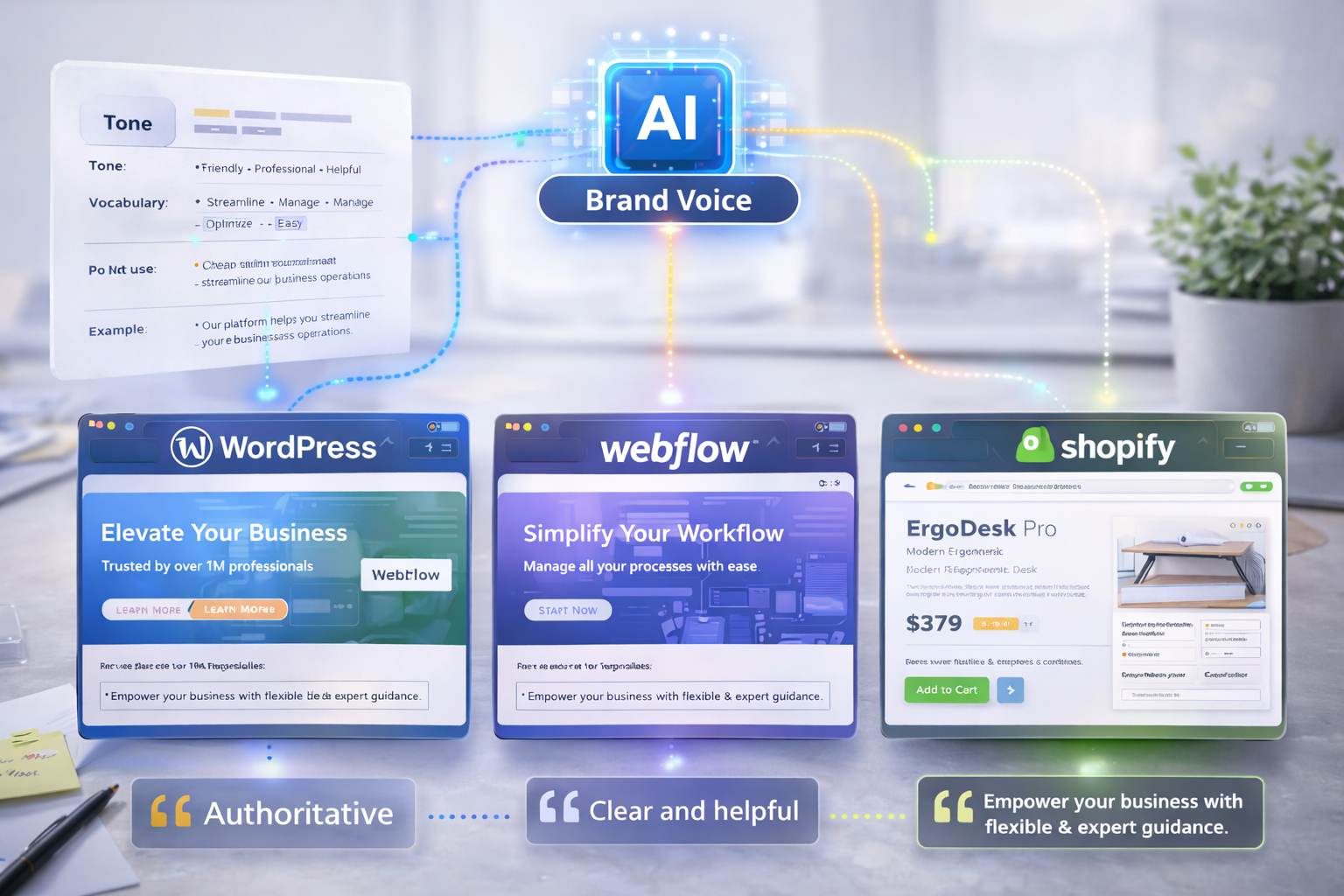
Publishing across WordPress, Webflow, and Shopify requires a cohesive data and workflow layer. The architecture should decouple content creation from formatting while enforcing voice at the content entry point.Key design goals:
- Single source of truth for voice guidelines and content briefs.
- API-enabled publishing connectors to each CMS/commerce platform.
- LLM-friendly prompts and templates that embed voice constraints.
- Auditable state management: who changed what, and when.
A practical pattern is a centralized Content Brief repository that feeds three downstream paths: the AI drafting stage, the human editorial stage, and the CMS publication stage. Each path enforces voice constraints through checks and prompts. For example, a Shopify component page and a WordPress article should originate from the same brief, but render differently according to platform best practices. The central brief ensures consistency while respecting platform-specific constraints.Implementation tips:
- Use a modular voice profile encoded in a machine-readable format (JSON or YAML). Include fields for tone, formality, sentence length, and preferred vocabulary.
- Adopt a tiered content model: headlines, deck, body, CTAs, and meta text. Each tier has its own voice constraints and quality checks.
- Establish API-based publishing pipelines with idempotent operations. Idempotency prevents duplicate content and drift across platforms.
Content Flow, Roles, and Approvals
At scale, the content lifecycle must be explicit and fast. A well-defined flow minimizes drift and accelerates time-to-publish.Core roles often include:
- Brand Steward: Maintains the voice profile and approves major editorial directions.
- Content Strategist: Crafts briefs aligned with brand goals and SEO targets.
- Editor: Oversees copy quality and ensures alignment with guidelines.
- Content Publisher: Executes CMS publishing with platform-specific requirements.
- QA Auditor: Verifies voice consistency, accessibility, and technical readiness.
A practical workflow looks like this: a content brief is created, the AI drafts a first version, the editor refines tone and structure, the QA auditor checks for voice compliance and accessibility, and finally the publisher pushes to the CMS via API. Each step has a defined SLA, and every artifact carries a verifiable voice stamp for auditing.Templates are your friend here. Use briefs that include:
- Audience and intent
- Voice constraints (tone, vocabulary, punctuation preferences)
- Key messages and the brand’s value proposition
- SEO and accessibility requirements
- Platform-specific notes (WordPress best practices, Shopify product page conventions, Webflow CMS fields)
Maintaining Tone Across CMS
Tone consistency means the same brand personality shows up, whether the reader is scanning a product description or an in-depth article. This requires translating abstract adjectives into concrete language patterns.Concrete steps to enforce tone:
- Define tone in three dimensions: formality, warmth, and action-oriented language. For example, “We help you grow” vs. “Grow with us” demonstrates a deliberate stance.
- Map tone to content types. Product pages may be concise and benefit-focused; in-depth guides may be more explanatory but still align on vocabulary and rhythm.
- Maintain sentence length targets by content type. Shorter sentences for product copy; measured, varied sentences for educational content.
- Use lexical controls: preferred synonyms, domain terms, and disallowed terms. Create a controlled vocabulary list for editors and writers.
Regular voice audits are essential. Schedule quarterly checks where a panel reviews a random content sample against the voice profile. Capture notes and feed them back into the Brief templates to close the loop.
Automation, Prompts, and Tools
Automation is what makes scale possible without sacrificing quality. The core idea is to automate the repetitive, predictable parts of writing while preserving human oversight for nuance and accuracy.Practical prompts and templates to deploy:
- Voice-locked briefs: “Write a 900-word article in the brand voice about [topic], using the following tone constraints: [tone], [vocabulary], and [CTA]. Include data points and quotes from credible sources.”
- Platform-aware drafts: “Create a WordPress article with a compelling meta description and an h2 structure optimized for SEO. Then generate a Shopify product narrative variant with the same core messages but platform-tailored features.”
- QA prompts: “Review this draft for tone consistency, sentence length, and vocabulary alignment with the brand profile. Flag any deviations and propose alternatives.”
- Voice taxonomies: Maintain a living dictionary of preferred terms and prohibited terms. Use automation to flag deviations during drafting.
Prompts live in a centralized prompt library attached to the content briefs. When a writer or AI agent accesses a brief, the system injects the voice guidelines automatically, ensuring consistency from first draft to final publish.
Measuring Success: ROI and Quality
The true test of a scalable brand voice is not only perception but performance. Track both qualitative and quantitative signals to confirm improvement over time.Key metrics to monitor:
- Brand Consistency Score: A rubric-based score from 1–5 on tone, vocabulary, and structure across a sample of articles per quarter.
- Publishing Velocity: Time from brief creation to live publish, per platform and per content type.
- SEO and AI-Visibility: Organic traffic, rankings for target keywords, and engagement signals that AI search increasingly values.
- Content Quality and Relevance: Reader engagement metrics (time on page, scroll depth, shares) and error rates in QA.
- Platform-specific Performance: Conversion rates on Shopify product pages, time-to-publish on Webflow, and editorial efficiency on WordPress.
Use dashboards that align to governance goals. Overlay voice audits with publishing metrics to identify drift before it compounds. The outcome should be a clear correlation: better fidelity to voice coincides with higher engagement and better SEO signals.
Governance + Automation: A 5-Step Framework
To operationalize the concepts above, adopt this concise, repeatable framework. Each step includes concrete actions and checklists.
- Establish the Brand Voice Profile and Style Guidelines. Create a living document with adjectives, allowed phrases, and disallowed terms. Publish a short, visual style guide for quick reference by editors and writers.
- Convert the voice profile into machine-readable rules and templates. Build a Content Brief schema that feeds AI prompts and human editors. Ensure the schema supports WordPress, Webflow, and Shopify fields.
- Implement API-based publishing pipelines and a prompt library. Automate routine checks such as tone compliance and meta data generation. Use versioning to track changes to voices and briefs.
- Schedule regular voice audits and platform-specific quality reviews. Capture findings and feed them back into the Brief templates. Maintain an auditable trail of approvals and changes.
- Iterate on the voice guidelines based on audience feedback and performance data. Update prompts and templates to align with evolving brand priorities and market conditions.
Bonus: run quarterly cross-platform content reviews to ensure that voice remains cohesive across channels, and adjust platform-specific renderings to preserve the central narrative.By combining a concrete governance model with automated workflows, you scale consistently without sacrificing the brand’s unique character. This approach helps marketing leaders and agencies deliver reliable, scalable content across WordPress, Webflow, and Shopify—and demonstrates clear, measurable ROI over time.